Britain has always been a nation of talkers. Put a microphone in front of a comedian, a local historian or two mates arguing about football, and something worth hearing tends to come out. That is why the UK podcast scene keeps producing shows that travel far beyond these islands, and why it is still unusually easy to join. You do not need a studio, a producer or a commissioning editor. You need a decent microphone, a quiet room, somewhere to host your audio and a reason to press record every week.
What follows is the version of that advice worth having before you spend a penny.
Start with the show, not the shopping list
Most failed podcasts die of vagueness. Before you look at microphones, write one sentence that describes the show to a stranger: “A 25-minute interview show about people who run small businesses in Sheffield.” If you cannot write that sentence, you are not ready to record, and no amount of equipment will fix it.
Then decide three things and hold to them: length, frequency and format. A fortnightly show of 30 minutes that actually appears twice a month beats a weekly show that collapses in March. Pick a length you can produce on a bad week, not a good one. Twenty to forty minutes suits most conversational formats; documentary-style shows can run longer, but every extra ten minutes is editing time you will have to find again and again.
Record a pilot. Then record two more episodes before you publish anything. Three finished episodes quickly teach you what your format really needs — and give you a buffer for the week when your guest cancels.
The kit that actually matters
You can spend a fortune on podcast gear and sound worse than someone with a £60 microphone in a cupboard full of coats. Spend in this order instead:
- The room. Free, and more important than any purchase. Soft furnishings, carpets, shelves and curtains absorb echo. Kitchens, bathrooms and bare sparerooms make everyone sound like they are shouting down a pipe.
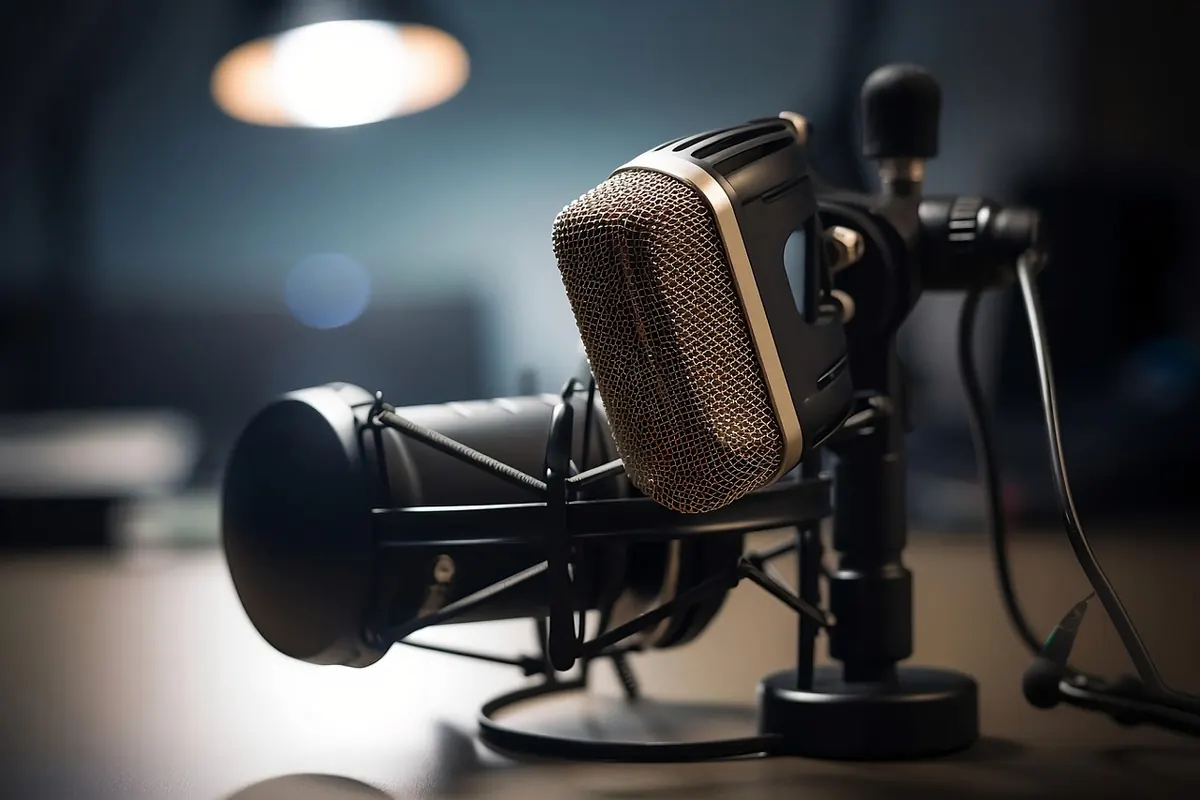
- One microphone. A dynamic USB microphone is the sensible first buy: it plugs straight into a laptop, rejects some of the room and needs no extra box. Condenser microphones are more sensitive, which is a problem in an ordinary British living room.
- Closed-back headphones. Wired, comfortable, and worn by you and every guest. Monitoring through laptop speakers guarantees howling feedback.
- The small stuff. A desk stand or boom arm, a pop filter or foam windshield, a spare cable and a spare SD card if you record to a handheld.
- Later, if you enjoy it. An XLR microphone with an audio interface, or a small multi-track recorder if you plan to interview people in person.
Skip the mixer. Skip the acoustic foam panels that make a room look like a murder documentary and do less than a duvet. If money is tight, borrow a microphone, record on a phone for a month and spend nothing until you know the show is real.
Getting a decent recording
Position
Ten to fifteen centimetres from the microphone, slightly off to one side so you are not breathing directly into the capsule. Stay there. The single biggest cause of amateur-sounding audio is a speaker drifting towards and away from the mic mid-sentence.
Levels
Record at 24-bit, 48 kHz if your software allows, and aim for peaks around −12 to −6 dBFS. Never let the signal hit zero; a clipped recording cannot be repaired. If you are using a phone as a backup recorder, put it on aeroplane mode first.
Remote guests
Ask your guest to wear wired headphones, sit somewhere soft and close the window. Where possible, use a service that records each person locally rather than relying on the internet call, so a wobble in someone's broadband does not ruin the interview. Always run a thirty-second test, and always keep a backup recording.
Hosting, RSS and getting listed
A podcast is not an app or a channel. It is an audio file and an RSS feed — a public list of episodes that podcast apps read. Your hosting company stores the audio, generates that feed and counts downloads. That is all it does, and it is the one thing you should pay for.
Choose a podcast media host rather than a general web host, and check two things: you keep control of your feed and you can move it to another provider later without losing your listeners. Once your feed exists, submit it to Apple Podcasts, Spotify, Amazon Music and the smaller directories and apps such as Pocket Casts and Podcast Addict. Prepare square cover art at 3000 × 3000 pixels, a clear show title and a description that explains the show in the first two lines.
Do not host episode files on a personal website, and do not treat YouTube as your only home. Video has its place, but it is not where podcast listening happens.
UK copyright: the short version for beginners
Copyright in the UK arises automatically when you create a recording — you do not register anything. If you have a co-host or a regular contributor, agree in writing who owns the show and what happens if someone leaves. Get a guest's permission on tape to record and publish.
Music is where most newcomers come unstuck. Using a commercial track — even thirty seconds of it — generally requires clearance from the record label side and the publishing side, and it is not a box you tick on a form. For an independent show, the practical answer is: use music you have a licence for. That means royalty-free libraries with clear terms, or Creative Commons material with the required credit.
Quoting a book or a news article in a review or discussion may fall within the fair dealing exceptions, but the American idea of “fair use” does not apply here, and repeating a chunk of someone else's work is not the same as commenting on it. Archive audio, television sound and other people's podcast clips all need permission.
Two more things worth knowing. If you collect personal information about guests — an email address, a story about their health — you have small but real duties under UK data protection law, so tell people what you are doing with their details and delete what you do not need. And if you plan to make damaging factual claims about a named person or business, check your evidence. This is not legal advice; if money, reputations or contracts are on the line, take proper professional advice before you publish.
The upside of the UK rules is freedom. On-demand audio is not regulated by Ofcom in the way broadcast radio is, so nobody is going to tell you your show must be a certain length or that you cannot swear. That freedom sits alongside responsibility, and the responsibility mostly amounts to: be accurate, get consent, and do not use other people's music.
Your first month, step by step
- Write your one-sentence premise and decide the length and schedule.
- Record a ten-minute test in two different rooms and listen back on headphones. Pick the better room.
- Set up hosting and claim your show name before someone else does.
- Record three episodes with borrowed or basic gear. Do not publish yet.
- Edit one episode properly, cut the padding ruthlessly, and settle on a repeatable workflow — a template, an intro, an outro.
- Publish the first episode, submit the feed to the main directories, and personally tell twenty people who might genuinely enjoy it.
Expect growth to feel slow. Most shows find their first hundred listeners through guests, friends, local groups and short clips shared where their audience already spends time. The shows that last are rarely the best-produced ones in the first year; they are the ones that keep turning up. Set a schedule you can keep, protect one evening a week for editing, and give it twelve episodes before you judge it. If you still enjoy making it at that point, you have a podcast.
Photo: Studio_Iris / Pixabay